What is BYD Tang L — and where does it fit
-
The Tang L is the latest flagship large SUV from BYD, unveiled in January 2025 and launched on April 9, 2025.
-
It is positioned above the older Tang models — meaning larger size, more space, more luxury, more performance.
-
The Tang-family SUVs (including Tang L) are part of BYD’s “Dynasty”/“New Energy Vehicle” push — meant to be flagship SUVs combining EV/PHEV flexibility with premium features.
In short: Tang L is BYD’s big-size SUV ambition — combining full EV or plug-in hybrid power with premium comfort and roomy 7-seat practicality.
Size, Layout & Design — Spacious, Premium, Bold
Dimensions & Layout
-
Exterior dimensions: 5040 mm (length) × 1996 mm (width) × 1760 mm (height). Wheelbase is 2950 mm.
-
Seating: 2 + 3 + 2 → total 7 seats.
-
Cargo / space: The boot/trunk (with all seats up) reportedly ~ 675 L, expanding up to ~ 1,960 L when 2nd & 3rd rows folded.
-
For a big 7-seater SUV, that’s quite generous — balancing family / group-travel needs with flexibility (fold seats for cargo).
Exterior & Design Language
-
Tang L carries BYD’s “Loong Face” (formerly “Dragon Face”) design — a front fascia with distinctive “dragon whisker”-style air intakes, split headlights linked by chrome trim.
-
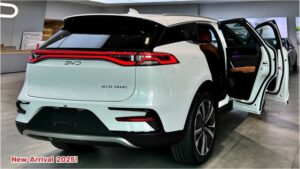
The rear taillights draw design inspiration from traditional Chinese bamboo-weaving techniques (a cultural / aesthetic touch rather than purely functional).
-
Overall, the styling aims to combine bold presence (a big SUV) with a blend of modern EV-SUV cues and cultural design motifs — pretty unique in the current global EV/SUV market.
Powertrains & Performance — Electric & Plug-in Hybrid Options
One of the standout aspects of Tang L is versatility: you have full-electric (EV) and plug-in hybrid (PHEV / DM) options.
EV Versions (Pure Electric)
-
Battery: 100.5 kWh LFP “Blade” battery pack on BYD’s “Super e-Platform.
-
Drive: Some variants are rear-wheel drive (RWD), others are all-wheel drive (AWD) with dual motors.
-
Performance (AWD top-spec): ~ 810 kW total power (~1,086 hp), torque ~ 860 Nm, 0-100 km/h in ~ 3.9 s, top speed around 265 km/h.
-
Driving range: Official CLTC-rated ~ 600 km on a full charge.
-
Charging: Uses a high-voltage 1,000 V architecture — enabling ultra-fast DC charging (BYD calls it “flash charging”). DC 30–80% can be very quick (though actual charger access depends on infrastructure).
Plug-in Hybrid / DM (Electric + Internal Combustion) Variants
-
Tang L is also offered as a PHEV: generally a 1.5 L turbocharged petrol engine + electric motor(s) + battery (~ 35.6 kWh LFP in some variants).
-
For example: the “DM-p” version (4WD + hybrid) delivers up to ~ 544 hp combined, 0-100 km/h in ~ 4.3 s, and uses E-CVT.
-
Electric-only range (on battery) in hybrid variants: ~ 175–200 km (CLTC) depending on sub-variant.
-
Combined (battery + fuel) total range (electric + petrol) is large — giving flexibility especially where charging infrastructure is not reliable (like many countries outside major Chinese cities).
Interior & Comfort — Tech + Luxury + Practicality
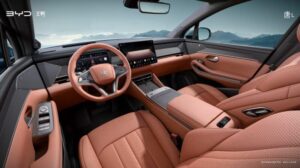
The cabin of Tang L aims to mix luxury, tech, and family-SUV practicality.
Highlights
-
Central 15.6-inch rotatable touchscreen infotainment system + digital instrument cluster + augmented-reality HUD (heads-up display).
-
Steering wheel: four-spoke, flat-bottom design. Gear selector is a shift-by-wire stalk on the column.
-
Interior finishes: dual-colour theme, ambient lighting, real bamboo-wood accents (a cultural / premium touch), high-quality upholstery — all aiming at a “premium-but-practical” feel.
-
Comfort features: front seats (and maybe 2nd row, depending trim) with heating, ventilation, and even massage support; wireless charging pads; premium sound system (e.g. Dynaudio in higher trims); and more content depending on variant.
-
Versatile seating & cargo: as mentioned above, 7 seats and big cargo capacity (up to ~ 1,960 L with seats folded) — useful for families, travel, cargo + passengers.
Pricing & Global / Regional Context
-
In its home market (China), at launch (April 2025), Tang L (depending on variant) is priced around 229,800 – 289,800 RMB.
-
Roughly translated (depending on exchange rates), that places it as a premium but (for what you get) relatively well-priced large SUV + EV / PHEV.
-
I saw a reference (from a Pakistani website) suggesting a “2025 BYD Tang L” price in Pakistan as ~ PKR 7,112,000 (~ US$25,400).
-
Important caveat: That Pakistani listing’s dimensions and some data don’t match global official specs — so the price / spec there may be speculative or for an import.
-
-
Because Tang L is a brand-new 2025 model, real-world availability outside China is still limited (or just beginning), which affects price, support, charging infrastructure etc.
What Makes Tang L Stand Out — & What to Watch Out For
Strengths & Highlights
-
Blazing performance + utility: For an EV SUV to produce ~1,086 hp and 0-100 km/h in ~ 3.9 s — while still being a 7-seater SUV with big cargo space — is a rare (maybe unique) combination.
-
Flexible power train options: Want 100% EV when you have charging access, but also like hybrid reliability when you don’t? Tang L’s PHEV versions deliver that.
-
Modern luxury + smart tech: From LiDAR-based ADAS to premium interiors, big screens, and comfort features — feels like a luxury SUV, not a bare bones EV.
-
Great for families / groups / long trips: Space, seating, cargo volume, and hybrid option make it versatile.
Possible Drawbacks / Risks
-
Charging infrastructure dependence: The “ultra-fast charging” and “1000 V high-voltage system” shine only where fast DC chargers exist. In many countries (especially outside major urban areas), this might not be true — limiting EV benefits.
-
Availability / service / spares (outside China): As a new model, for places outside China it may be hard to get full dealer support, replacement parts, and warranty support.
-
Heavy & large: Big SUVs with massive batteries tend to be heavy — which can affect handling, braking distances, tyre wear, and “real-world” range especially if roads or conditions are not ideal.
-
Real-world vs claimed range/performance gaps: As with all EVs, official CLTC (or manufacturer) specs — on range, charging speed, acceleration — may not match real-world driving conditions (hot/cold weather, road surface, driving style, AC usage, load, etc.)
Over All point of view
The Tang L feels like BYD’s statement: “We can build an SUV that’s a super car, a family car, and a luxury car — all in one vehicle.” With its cutting-edge EV technology, serious acceleration, and practical 7-seat layout, it targets a niche of people who want power + space + modern EV-era amenities — without sacrificing one for the other.
If I were to judge it: Tang L is one of the most exciting large EV/SUVs of 2026 — a car that may make sense now (especially for someone in a city or region ready for EV/hybrid tech), or could look very different if bought in a region without charging infrastructure or with poor after-sales support.
But for most developed countries this cars is not just a car it is all in one for everyone who wish to have comfort, super car, a family car, and a luxury car all in one vehicle, you can also watch this video for further information